
What are you looking at? The Research Behind the Image
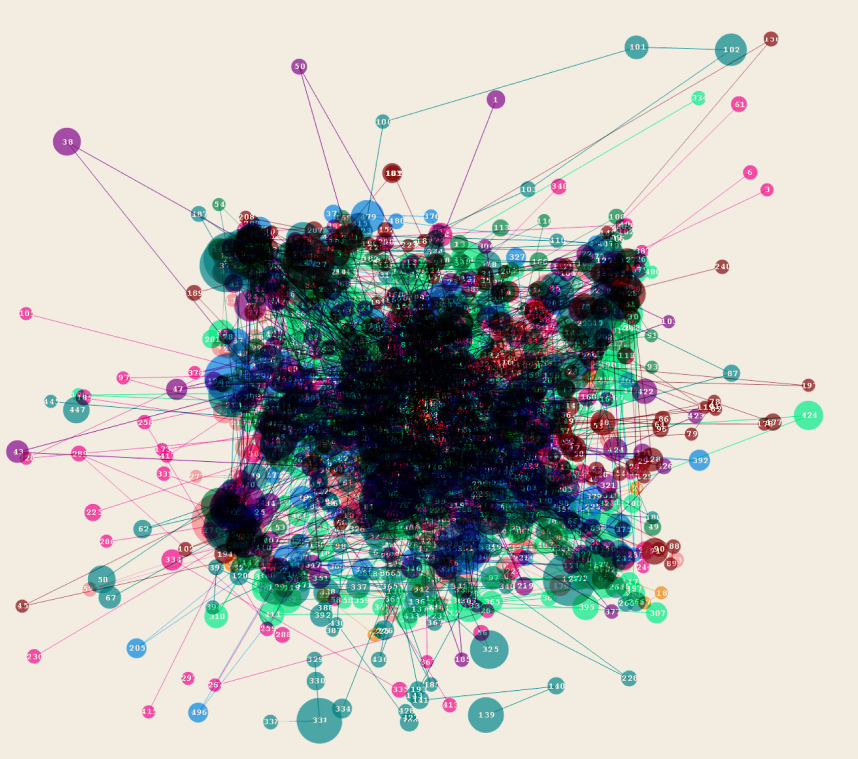
That striking image you’re looking at — a dense, colourful web of hundreds of thousands of nodes and connections — is a direct product of research into how people actually see when they play video games. It’s gameplay made visible.
THE RESEARCH
This study set out to understand how the game interface shapes player immersion and how it supports or quietly works against it. Using eye tracking, could we reveal the subconscious use of the UI? Ten participants were observed as they played a first-person shooter, and watched footage from a range of games. Every glance, every pause in gaze, every fixation point was recorded.
The research builds on a well-known psychological phenomenon called change blindness — our brain’s remarkable ability to miss obvious changes in our visual field when we’re focused on something else. Think of the famous gorilla experiment, where people counting basketball passes completely failed to notice a person in a gorilla costume walking through the scene. The question was: does immersion in a game work the same way?
From data to image
The image above represents the eye movement and fixation data collected across all participants — rendered as a network graph. Each node is a fixation point. Each connection is a path the eye travelled. The size of each node reflects how long the gaze lingered. What looks like an abstract, almost cosmic explosion of colour is actually a precise map of human attention under the influence of play.
The dense, tangled core shows where attention converged — the central screen area where most action happens. The lighter, more scattered nodes at the edges represent fleeting glances outward: to the HUD, to peripheral movement, to the unexpected.
What the data showed
Several interesting things emerged. Players in unfamiliar game environments paid significantly more attention to the HUD — the on-screen interface — using it as a reference point with the main game visuals to make sense of their surroundings. In familiar environments, their gaze was far more confident and focused.
There was also a striking finding around concentration: players who had just completed a short gameplay session showed noticeably longer, more sustained visual fixations afterwards compared to those who hadn’t played. In other words, even a brief burst of gaming appeared to sharpen visual attention. This supports wider research* suggesting that action games can improve the visual system’s ability to track and process information — by as much as 30% in regular players.
Why it matters for game design
Understanding exactly where players look — and crucially, what they don’t see even when it’s right in front of them — has real implications for how games are designed. The research proposed using this kind of gaze data to drive smarter rendering: rendering the area of sharpest attention in full detail while simplifying the periphery, saving processing power without the player ever noticing. It’s UX and performance optimisation driven by human biology.
This research sits at the heart of what Checkpoint UX is about: understanding the player experience not through assumption, but through evidence.
If you’d like to know more about this research drop us a line.
*Action video game modifies visual selective attention. Bevelier & Green. 2003